
Google Is About to Start Selling Ads Inside Its Answers. What That Means for You.
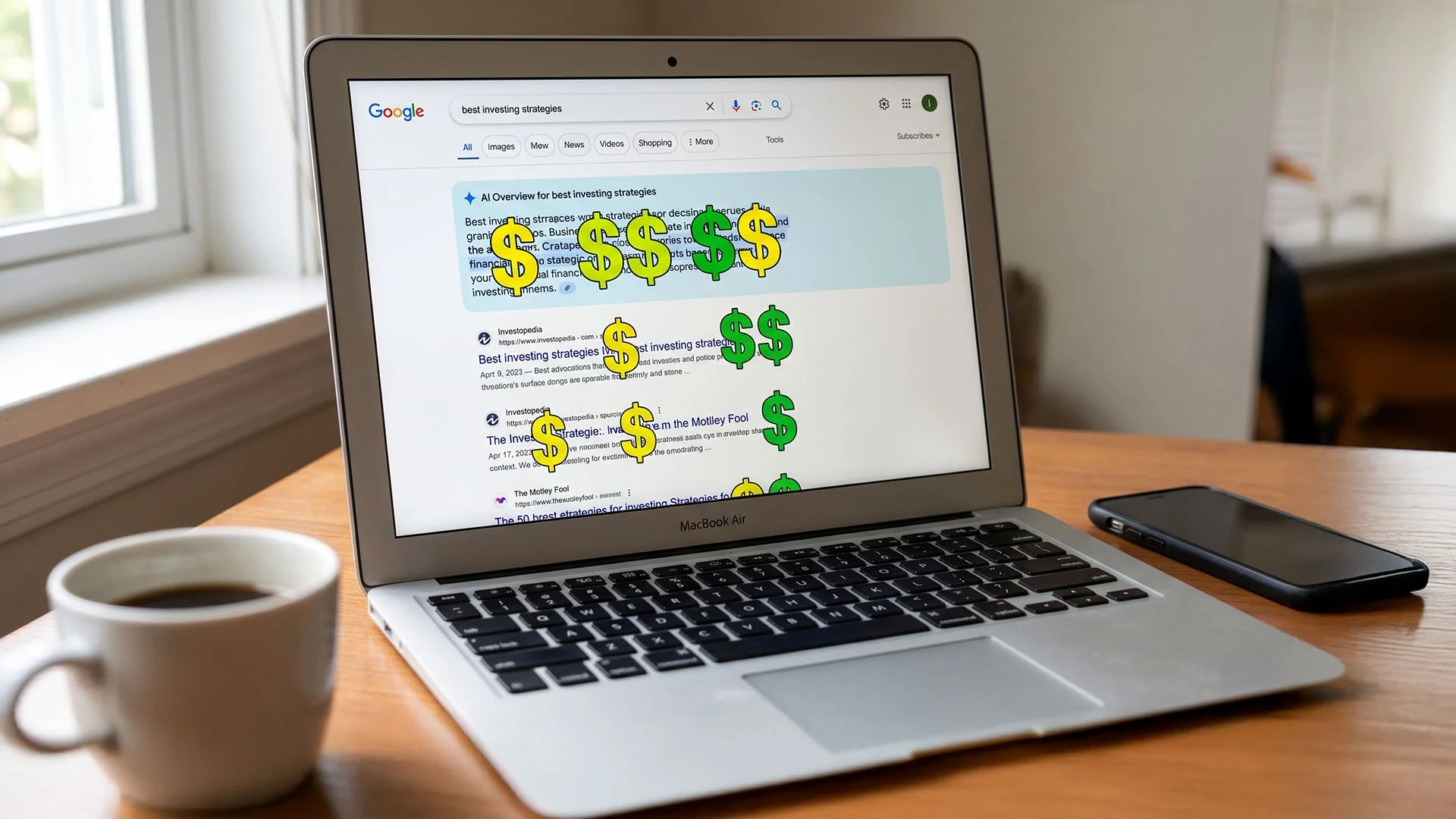
If you've searched for anything on Google lately, you'll have noticed it doesn't quite work the way it used to. Ask it a question and, more often than not, you get a tidy AI-written answer sitting at the top of the page before you've even reached the familiar list of links. That's an AI Overview, and alongside its chattier cousin "AI Mode", it's quietly rewriting the rules of how customers find businesses online.
There's an enormous amount of noise about all this at the moment. Scroll through LinkedIn or any marketing forum and you'll find no shortage of self-appointed experts confidently telling you exactly what to do about "GEO", "AEO" and whichever new acronym was invented last Tuesday. I'd suggest treating most of it with a pinch of salt. The truth is that we are still very early in all of this. Nobody, and I mean nobody, knows precisely how it's going to settle down, which tactics will still matter in two years, or even when we in the UK will get full access to some of the tools and products Google is rolling out elsewhere. Anyone telling you otherwise is guessing with confidence.
So rather than add to the hype, I want to give you a practical look at what's genuinely happening, what it means for a small business like yours, and what I think is actually worth doing about it.
A quick recap, since you've probably already used it
You almost certainly know what AI Overviews are because you've been using them, whether you meant to or not. When you search for something like "how do I get rid of limescale" or "best way to insulate a loft", Google now generates a written summary pulling together information from several websites, with a handful of source links tucked off to the side.
AI Mode goes a step further. It's a more conversational experience, closer to having a back-and-forth chat, where you can ask a complicated question, then follow up, then refine, all without starting a fresh search each time. It arrived in the UK in the summer of 2025 and has grown extraordinarily quickly. By its first birthday Google said it had passed a billion users a month worldwide.
The mechanics under the bonnet don't really matter to you as a business owner. What matters is the consequence: a growing slice of people now get their answer directly from Google, on Google, without ever clicking through to a website. And that changes the game for all of us.
The uncomfortable truth: clicks are falling, and we need to accept it
Across the board, clicks through to websites are dropping when an AI Overview appears. The independent studies vary in their exact figures, but they all point the same direction: when Google answers the question itself, far fewer people bother clicking through to the sites that the answer was built from. Some research suggests the click-through rate on the top result can more than halve when an AI summary sits above it. The number of searches that end without any click at all has climbed substantially.
This is happening across AI Overviews, AI Mode, and the wider rise of tools like ChatGPT, where people increasingly ask their question and never touch a search engine in the first place. I'm not going to sugar-coat it or pretend there's a clever trick to make it go away. There isn't. The behaviour of your customers is changing, and fighting that is a waste of your energy.
So here's where I'd encourage you to shift your thinking entirely.
Start treating an appearance in an AI Overview as a win in its own right. If Google quotes your business, cites your website, or pulls your information into that answer at the top of the page, that is valuable even if nobody clicks. Your name is being put in front of someone at the exact moment they're looking for what you do. That's brand visibility you didn't have before, sitting in the most prominent spot on the page. A few years ago we'd have called that priceless. The fact that it doesn't always come with a click doesn't make it worthless.
And celebrate the clicks you do still get, because they're better. Think about it from the customer's side. If they've already read a summary of the basics and still decide to click through to your site, they're not idly browsing. They've got past the simple question and they want more, from you specifically. The casual, "just checking a fact" traffic is the stuff that's disappearing, and frankly it was never going to ring your phone anyway. The person who clicks through now is more informed, further along, and more likely to actually become a customer. You may well find your traffic numbers drop while your enquiries hold steady or even improve. Fewer, better visitors is not a bad trade.
If you take one thing from this, let it be that. Stop measuring success purely by how many people land on your website, and start paying attention to whether you're showing up, being mentioned, and turning the right visitors into customers.
How ads in AI are working, where they've actually launched
Now, the part everyone's curious about: advertising. Google makes its money from ads, so it was never going to leave that fat AI Overview at the top of the page free of them forever.
In the countries where this has gone live, ads are appearing in a couple of ways. Some sit just above or below the AI-generated answer, much like the sponsored results you're already used to. More interesting are the ads appearing within the answer itself, woven into the AI's response. So if you ask something with a clear commercial flavour, say a question about the best way to solve a particular problem, the AI might fold in a sponsored product or service as part of its helpful reply, clearly labelled as "Sponsored" but sitting right there in the flow of the answer.
Google has been showing off newer formats too, where its AI builds a tailored advert on the fly. Picture someone asking a conversational question, and the AI assembling a bespoke little advert that answers it directly, drawing on the advertiser's website and product information. There's even a version with a chat agent built into the ad, so a potential customer can ask questions and get answers grounded in that business's own information, all without leaving the search results.
It's clever, and a bit unsettling, because the line between a genuine recommendation and a paid placement gets blurry when both are written in the same friendly AI voice. That's a concern plenty of people in the industry have raised, and one worth keeping an eye on.
But, and this is the crucial bit for you: ads inside AI Overviews and AI Mode are not live in the UK yet. As things stand, this is running in the US and a handful of mostly English-speaking countries, and the in-conversation AI Mode ads are still being tested in America only. Here in Britain, your standard search ads can still appear above and below an AI Overview, but not woven into the answer itself. So while it's useful to understand where this is heading, you don't need to do anything about the in-answer ads today. They're simply not an option for us at the moment.
Is Google quietly forcing us towards its automated tools?
This is the question I keep chewing over, and I'll be honest with you about my own position…
For small businesses on a careful budget, I've long been cautious about Google's more automated advertising products, the likes of Performance Max. My worry has always been the loss of control. You hand Google your budget and a fairly loose set of instructions, and it decides where to spend it. Too often I've seen modest budgets frittered away on irrelevant search terms or scattered across placements that do nothing for the business, the odd pound vanishing into a YouTube video that was never going to bring in a customer. When every pound counts, that lack of control is a genuine problem, and I've generally steered smaller clients towards tighter, more manual campaigns where we know exactly what we're paying for.
But the direction of travel suggests Google increasingly wants advertisers using its AI-driven, automated approaches in order to be eligible for these new AI placements. The narrowly targeted, manually controlled campaigns I've tended to favour look likely to be left out of the shiniest new spots. And Google has signalled that it intends to start automatically moving certain older campaign types over to its newer AI-powered system, rather than leaving it as a choice.
So yes, it does rather feel like our hand is being forced. If you want a seat at the table as these AI placements expand, you may have to embrace more automation than I'd ideally like, and give up some of that control I value so highly.
My advice for now is don't rush to throw your budget at automated tools on the strength of features that aren't even available here yet. But do keep an open mind, and when the time comes, test carefully and in small amounts. If you do experiment with an automated campaign, watch it like a hawk for the first month, set firm budget limits, and judge it ruthlessly on whether it actually delivers enquiries, not just clicks or impressions. The old discipline still applies, even if the tools are changing.
Nobody knows when the UK gets the full picture, and that matters
It is far from clear when, or even whether, the full suite of AI advertising tools will roll out here in the UK and across Europe. Google has been notably tight-lipped, and there's a significant reason for the caution: the UK competition regulator is currently taking a hard look at Google's dominance in search and search advertising. Google has formally been designated as holding a particularly powerful position in this market, which gives the regulator scope to impose rules on how it behaves, including around these very AI features. There's an active investigation and consultation underway as I write.
What that means in plain terms is that the UK rollout of AI advertising could be delayed, could come with conditions attached, or could end up looking quite different from the American version. We genuinely don't know. So if someone tries to sell you an urgent, expensive package to "get ahead of AI ads in the UK", be sceptical. You cannot get ahead of something that doesn't have a launch date and may be reshaped by regulators before it ever arrives.
So what should you actually do?
Keep doing the fundamentals well. A clear, helpful, well-structured website that genuinely answers your customers' questions is exactly what the AI is looking to draw from. Good honest content, a tidy site, and a properly maintained Google Business Profile remain the foundation. None of that has gone out of fashion.
Shift how you measure success. Stop obsessing over raw visitor numbers. Start asking whether you're appearing in these AI answers, whether your brand is being mentioned, and whether the visitors you do get are turning into enquiries. A quieter website that produces better leads is a win.
Be patient with the ads. The in-answer AI advertising isn't available here yet, and may take a while to arrive in a settled form. There's no need to act today, and plenty of reason to wait and see.
Stay sceptical of the hype. We are at the very beginning of all this. The people shouting loudest about the "rules" of AI search are, for the most part, guessing. A steady, sensible approach will serve you far better than chasing every new trick.
And if all of this feels like a lot to keep on top of while you're busy actually running your business, well, that's rather what I'm here for. If you'd like a hand making sense of where your business stands and what's genuinely worth doing, do get in touch.