
Back in May I wrote about Google preparing to sell ads inside its AI answers, and I said fairly firmly that it wasn't something UK businesses needed to worry about yet. Well, "yet" now has a rough date attached to it.
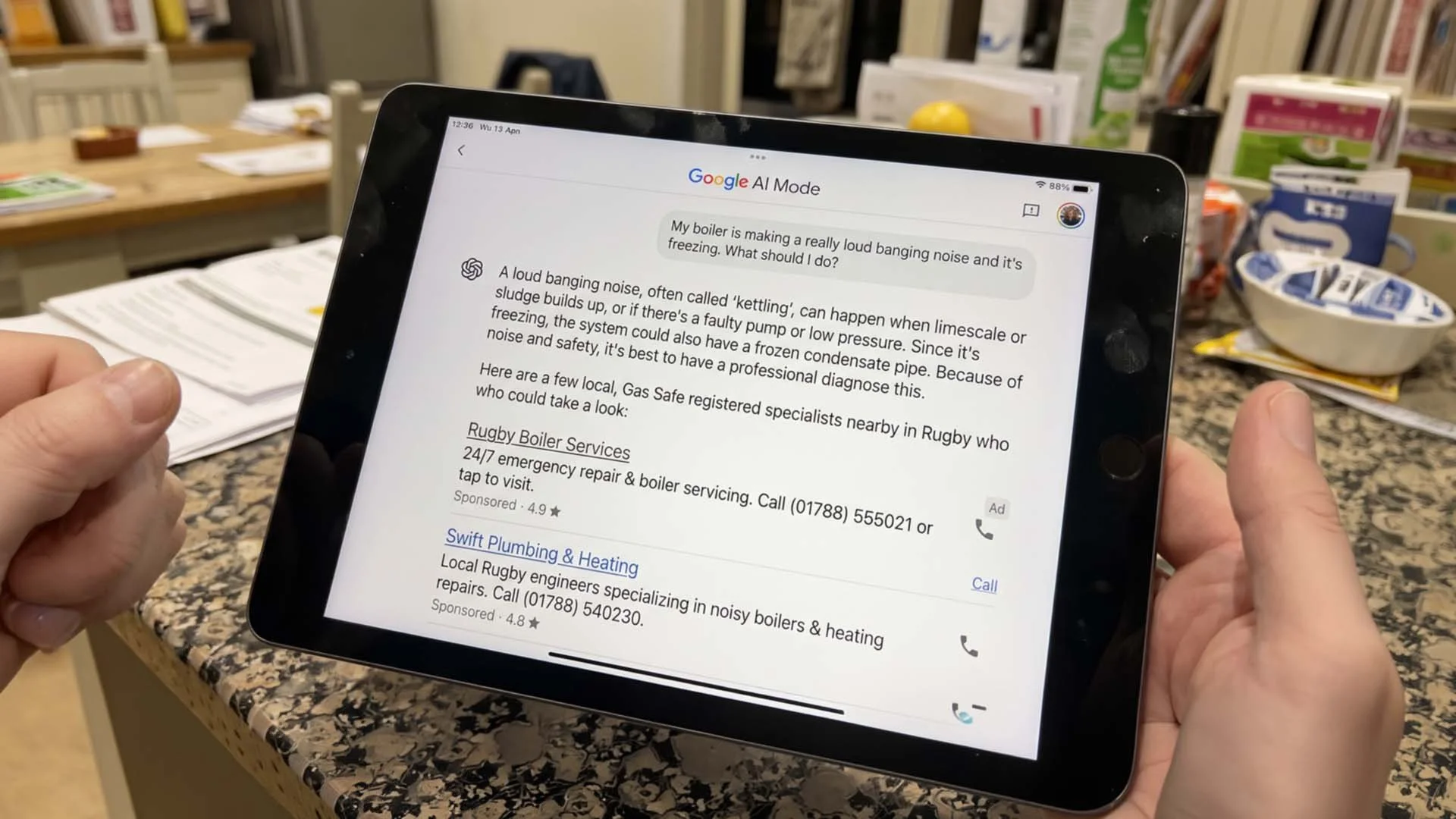
On 28 October, Google announced that it is expanding ads in AI Mode to ten more countries, and that in the final quarter of 2026 it plans to expand to more, including the United Kingdom. The final quarter ends on 31 December, so we could be talking weeks rather than months. If you don't run Google Ads, this is mostly a "good to know". If you do, it's worth ten minutes of your time, because your existing campaigns are likely to start appearing there automatically.
AI Mode is the more conversational side of Google Search. Rather than typing a few words and getting a list of links, you ask a proper question, get a written answer, then ask a follow-up, and so on, a bit like chatting to a well-read (and occasionally overconfident) friend. It's separate from AI Overviews, which are the short AI summaries that now appear at the top of many ordinary search results. Google says questions asked in AI Mode are, on average, three times longer than traditional searches. That detail matters more than it sounds, and I'll come back to it.
What Google has actually announced
Ads in AI Mode are now being rolled out in Australia, Canada, India, Kenya, Malaysia, New Zealand, Nigeria, Pakistan, the Philippines and Singapore. Brazil, Mexico and the UK are next on the list, with Google saying it plans to expand to them in Q4 2026. There's no firm UK date yet.
In the US, Google is going a step further with what it calls "multiturn ads". These can appear in the answers to follow-up questions, not just the first one, as people go back and forth with AI Mode. That's US-only for now, but I'd be surprised if it didn't follow us across the Atlantic eventually.
Google says all of these ads will be clearly labelled as "Sponsored". It also claims that people are comfortable with ads in AI Mode and that click-through rates are already similar between sponsored and organic product listings. That's Google's own research, so I'd take it with a small pinch of salt until we see some independent figures.
It's also worth knowing why Google is in a hurry. In its latest quarterly results, Google's Search revenue grew 12 per cent year on year, its slowest growth for a while, and, as Search Engine Journal reports, one of its senior executives named lower monetisation in AI Mode (in plain English, it isn't yet making as much money from ads there) as one of three reasons. When a company that makes most of its money from ads has a growing part of its product with fewer ads in it, you can guess what happens next.
What it means if you already run Google Ads
Google's help page on ads in AI experiences is surprisingly clear, so here are the main points…
You don't need to set anything up. Existing Search, Shopping and Performance Max campaigns are automatically eligible to appear in AI Overviews and AI Mode, using your existing budget. Search Engine Journal also reports that there's no way to opt out of AI Mode separately.
How your ads are matched depends on how your campaigns are set up. Google matches ads in two ways. "Direct" matching is the familiar one: someone searches for something with clear buying intent, like "emergency plumber Rugby", and ads are matched to that search. "Contextual" matching is the new one: someone asks a longer, more exploratory question, and Google matches ads to both the question and the AI's answer.
Google's own example is someone asking why their pool has turned green. The question isn't asking to buy anything, but the AI's answer talks about cleaning, so Google may show ads for pool cleaning products. For a local business, think of someone asking "why is my boiler making a banging noise?" and seeing an ad for a heating engineer.
Here's the important bit. Only the more automated options, such as broad match keywords, AI Max for Search, Shopping and Performance Max, are eligible for that contextual matching. Exact and phrase match keywords (where you tell Google precisely which searches you want to appear for) only appear when the question itself shows clear buying intent.
Google will write some of the words around your ad. In some placements, Google may show what it calls "AI explainers", short bits of text generated by its Gemini AI to explain how your ad relates to what someone is looking for. These can draw on your website and other public sources. You can't write them, edit them, approve them or opt out of them.
You won't be able to see AI Mode results separately. Performance from AI Overviews and AI Mode is lumped in with your normal campaign figures and search terms report. Your existing controls, such as negative keywords (words you've told Google not to show your ads for), still apply.
My take on it
This is opinion, so feel free to disagree…
In May I said it felt as though Google was nudging advertisers towards its more automated tools, and this confirms it. If you want your ads to appear in those longer, chattier conversations, Google wants you using broad match or one of its AI-driven campaign types. Those are exactly the tools I've been cautious about for small businesses on tight budgets, because they give Google more freedom to decide where your money goes.
Contextual matching could be very good for some businesses. Someone asking a detailed question about a problem is often closer to needing help than they realise. But it could also mean paying for clicks from people who were only ever after free advice. And because the figures are combined with everything else, it'll be harder to tell which of those is happening.
The AI explainers bother me a little too. Google writing words that sit alongside your advert, based partly on your website, means your website needs to be accurate and up to date. If your site still lists a service you stopped offering in 2022, don't be surprised if Google mentions it.
What I'd do now
First, don't panic and don't restructure everything. If your campaigns use exact and phrase match keywords, they'll carry on working much as they do now, and they'll still be eligible when someone asks a question with clear buying intent.
Second, tidy up your negative keywords. They're your main line of defence against irrelevant clicks, and that matters more when questions get longer and more varied. Once AI Mode ads arrive in the UK, look at your search terms report more often than usual, and watch for long, conversational searches that don't fit your business.
Third, check your conversion tracking. Google's automated bidding relies on knowing which clicks turn into enquiries or sales. If your tracking is broken or missing, automation is essentially guessing with your money.
Fourth, look at your website through a stranger's eyes. Are your services, prices (if you show them), areas covered and contact details correct? Google's AI may be reading it to describe your business, and your landing pages still need to turn visitors into customers.
If you do want to test broad match or AI Max, do it carefully: a separate campaign, a modest budget, and a weekly check. Then compare the cost per enquiry with what you get now.
Finally, don't forget the free stuff. AI Mode answers are still built from websites and Business Profiles, so good SEO and a well-kept Google Business Profile remain your best way to show up without paying for every click. If you're new to advertising on Google, my small business guide to Google Ads is a good place to start.
Need a hand?
If you run Google Ads and you're not sure how your campaigns are set up, or whether this change will affect you, I'm happy to take a look. I'll tell you plainly what's worth changing, and what's fine to leave alone. Just get in touch.